Seven minutes and 51 seconds of the North Lawn of the White House observed on the afternoon of July 15, 2015.
Author: Christian Williams
I make music, paint pictures, and write. I'm also the editor of Utne Reader magazine in the United States, where I write about arts, culture, and the nature of consciousness.
I Was Once a Good Little Boy (2017)
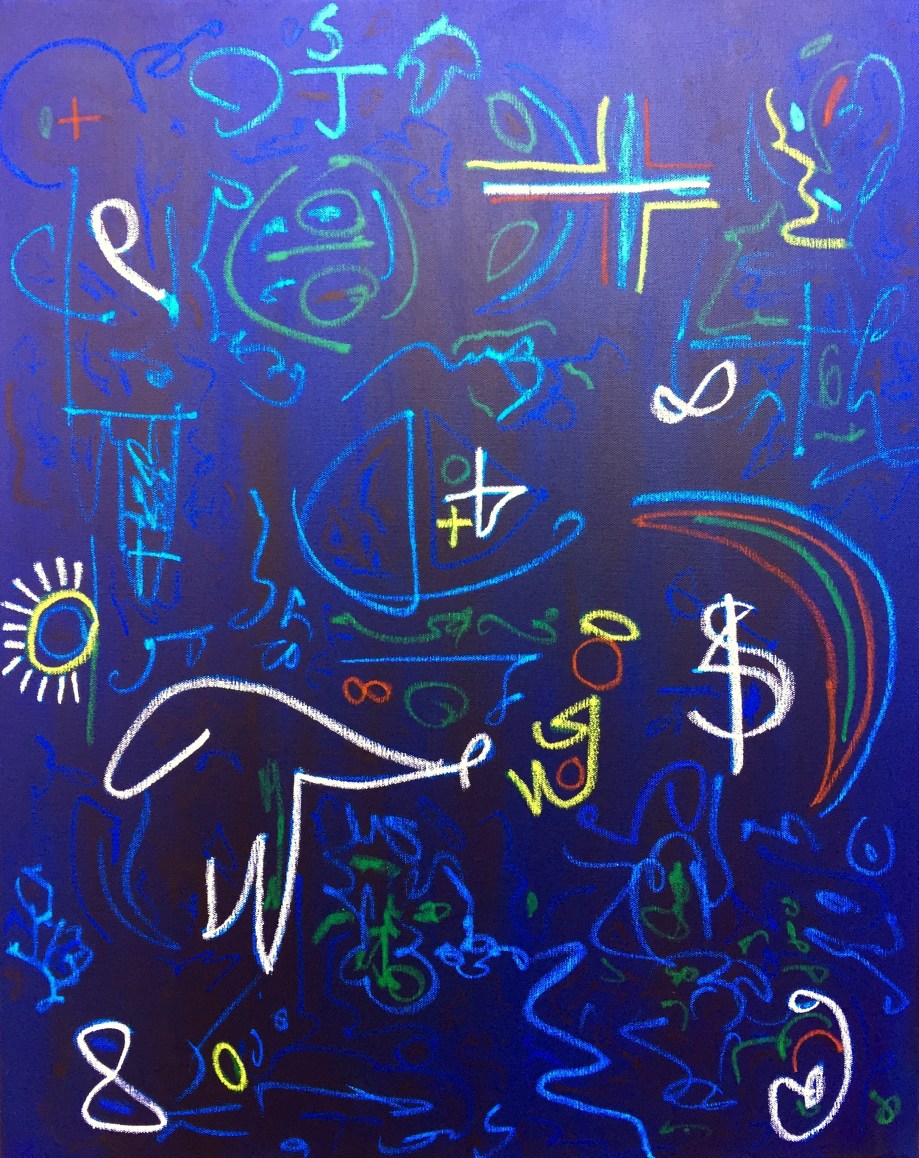
Acrylic and oil pastel on canvas
28 x 22 inches
An automatic drawing that revealed itself as a self-portrait with hindsight.
Back to Folk Music
It’s been eight years since I last performed as a solo folksinger, but on March 31, 2017, I dusted off some of my old tunes and even played a new one for an intimate show at Conroy’s Pub in Lawrence, KS.
It was a surprisingly gratifying experience for me, and I hope to have another opportunity to do it again soon. More than that, though, it got my creative juices flowing and I’ve begun working on a new album of folk songs that I hope to release digitally in Fall 2017. This time, I’ll be working with lyrics from old-time folk songs in the public domain and setting them to my own arrangements. At some point, I may be interested to write new songs from scratch, but for now I’m really enjoying the process of working with great words already written.
The aforementioned “new” song from the recent Conroy’s performance is my arrangement of the old folk standard “Rye Whiskey.” Lyrically, it’s a combination of a few well-known versions, and musically, the new arrangement gives an already timeless song a bit of a contemporary feel, in my opinion. Here’s what it sounded like at Conroy’s:
Si! (2017)

Acrylic on canvas
40 x 30 inches
SOLD in April 2017 to a private collector in Kansas
Responsive painting inspired by a live performance of Si!, a composition for tuba and live electronics composed by Karlheinz Essl; performed at Cider Gallery in Lawrence, KS on April 25, 2017 by Brett Keating and University of Kansas Prof. Bryan Kip Haaheim (North American Premiere).
This piece was one of seven spontaneously-produced paintings as I listened to Brett perform six separate electro-acoustic music compositions for trombone, euphonium and live electronics.
Here’s a video of Essl performing Si! in Innsbruck, Austria on November 29, 2015:
Wind Shadows (2017)
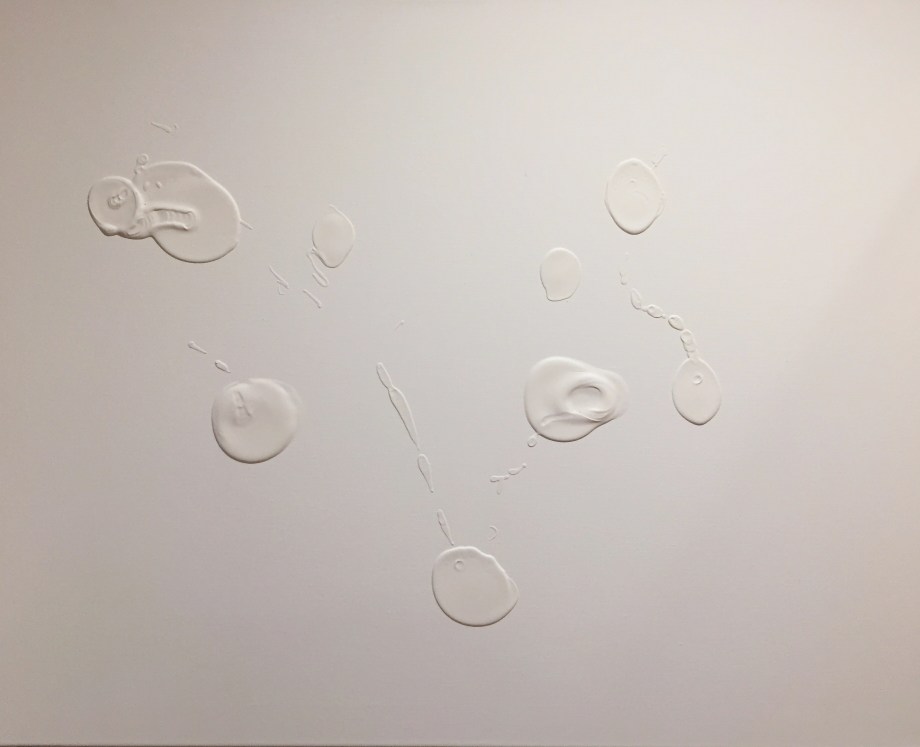
Gesso on canvas
24 x 30 inches
Responsive painting inspired by a live performance of Wind Shadows, a composition for trombone and closely tuned oscillators composed by Alvin Lucier; performed at Cider Gallery in Lawrence, KS on April 25, 2017 by Brett Keating.
This piece was the first of seven spontaneously-produced paintings as I listened to Brett perform six separate electro-acoustic music compositions for trombone, euphonium and live electronics.
Here’s a recording of the same piece performed by James Fulkerson (trombone) and Alvin Lucier (oscillator):
2017 – Wind Shadows
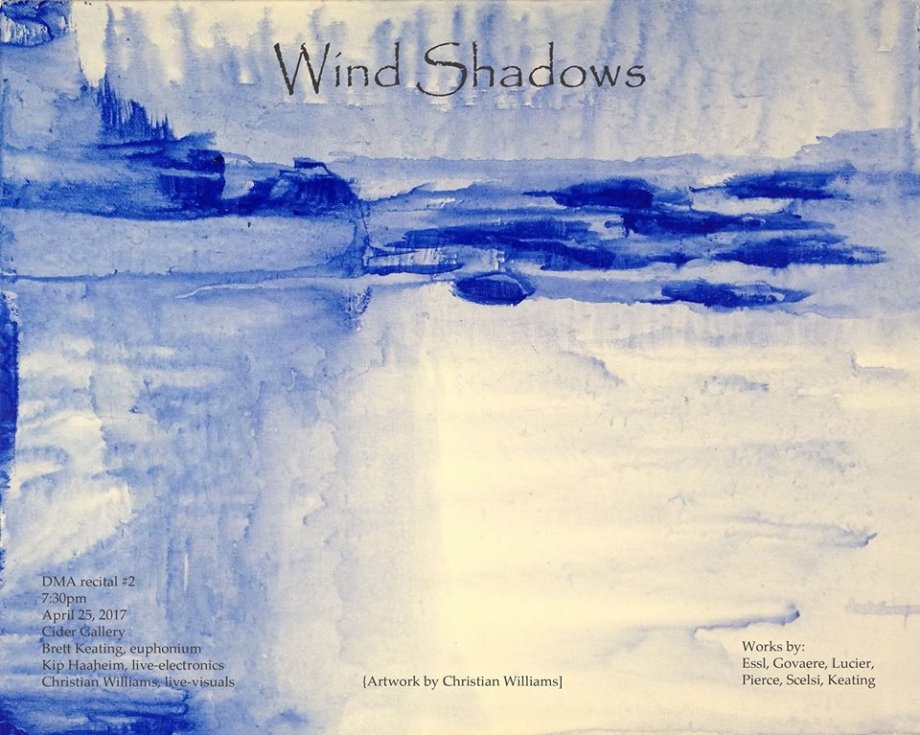
“Wind Shadows” was a multi-media, contemporary classical performance at Cider Gallery in Lawrence, Kansas, on April 25, 2017.
Composer and performer Brett Keating played an original electro/acoustic euphonium piece along with works by Alvin Lucier, Karleinz Essl, Stijn Govaere, Forrest Pierce, and Gianinto Scelsi. As Keating performed, I spontaneously painted in response to the music and produced a painting for each piece. Using the duration of each piece as the only parameter for each painting, some turned out better than others. The two highlights were the following pieces:

Si!
Responsive painting to a performance of Si!,
a composition for tuba and live electronics composed by Karlheinz Essl.
Wind Shadows
Responsive painting inspired by a live performance of Wind Shadows,
a composition for trombone and closely tuned oscillators composed by Alvin Lucier.
Invocation of Pure Expression
While I wholeheartedly support the act of creating without explanation or meaning, I know my art and music means more to me if it’s motivated by one or more of the following criteria. This is my Manifesto of Pure Expression:
I make art and music …
to remind myself that every moment, no matter how insignificant it may seem, can be meaningful if we choose for it to be so.
to extol the virtues of spontaneity, celebrate the majesty of the mundane, and embrace the beauty of imperfection.
that functions as a mirror to my insecurities, a vent for my frustrations, and an acceptance of my perceived shortcomings.
that emphasizes curation over creation.
for people who find it more interesting to answer the question “Do you like it?” rather than “Is it good?”
to do my part in promoting free culture.
BUT ABOVE ALL
to demonstrate that you, too, can make art and music.
The Way (2016)
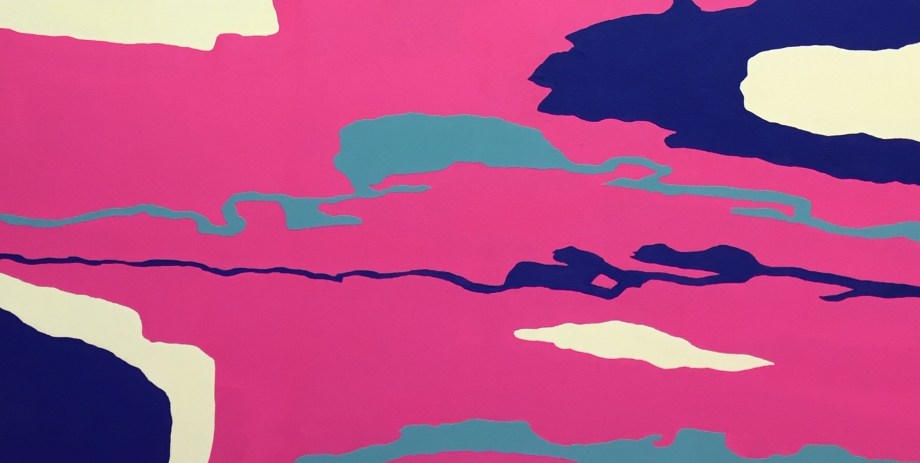
House paint on plywood board
24 x 48 inches
I followed the grain and allowed the wood to dictate the composition of this painting as an exercise in wu-wei.
What a Difference a Smile Makes
This summer has been a rough one for a lot of people. From terrorism at home and abroad, to violence by and against police officers, to a never-ending presidential campaign that will undoubtedly leave millions of Americans feeling alienated by the result, it’s easy to feel overwhelmed by the suffering, frustration, and hopelessness. So what can any of us do about it? Here’s one idea:
My friend Teri and I were talking recently about how being bombarded with bad news on a near daily basis was wearing us down. We noted that the easiest thing to do would be to stop paying attention to the news and remain blissfully ignorant, but we both understand that’s not the solution. Instead, Teri has decided to do something brilliantly simple to bring some balance into her life—she’s smiling more.
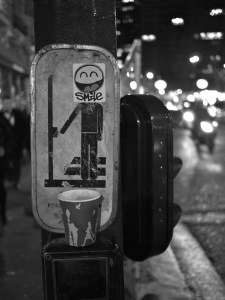
The idea came to her after a friend described a profound experience she recently had with a stranger. The friend said she was driving when she passed an African American man who was walking on the sidewalk. It was a really hot day and he was sweating profusely so she felt compelled to pull over and ask him if he needed a ride. He was confused by the offer but happily accepted. They got to talking and he said he was surprised because in his experience, young white women driving around by themselves don’t normally stop to ask if a black man needs help. She soon found out that the man was walking to the hospital to meet his recently born godson. When she arrived at the hospital, he relayed how
appreciative he was of her kind act because it just meant a lot to him to be acknowledged. She responded by giving the man a hug.
The story moved Teri to tears and got her thinking about what she could do to simply acknowledge the many strangers she crosses paths with on a daily basis. So she decided that the next time she passed someone while walking down the street, she’d push herself out of her comfort zone by making eye contact and smiling. The first time she tried it, an older woman stopped in her tracks, thanked her and complimented Teri on how nice she looked. The brief interaction made Teri’s day and she decided to pay it forward later on when she walked past a well-dressed man, smiled and complimented him on how nice he looked. He was as appreciative of the comment as Teri had been earlier. And just like that, Teri had interacted on a lasting and profound level with two complete strangers simply by smiling and acknowledging that they exist.
My conversation with Teri made me realize that hopelessness is a chosen perspective. When we allow the troubles of the world to weigh us down, we become blind to the real, everyday opportunities we have to actually make a difference in someone’s life. Wouldn’t it be something if the key to solving the world’s problems was as simple as a smile? I think Teri might be on to something.
Originally published in the Fall 2016 issue of Utne Reader.
Photo courtesy Juozas Salna, licensed under Creative Commons.
No Photos Necessary
It’s amazing how certain memories from childhood can stick with you and continue to shape your adult life. I’m still learning from a memory I have of a particular moment during a high school history class trip to Washington, D.C. and other sites related to the Civil War.
On a cloudy and chilly morning, we were walking around Gettysburg National Battlefield near the intersection of two stone walls called The Angle that was the site of the Confederacy’s last gasp in the fierce and bloody three-day battle. Aware of the historical significance of the site, I thought a photograph was in order, so I took a seat on the wall. As I sat there waiting for a friend to snap the photo, I felt the hair on the back of my neck stand up and the emotional weight of the place bear down on me. It’s the closest experience I’ve had to paranormal, but it wasn’t scary. Rather, I found it fascinating that a physical place was capable of conveying so much emotional energy, and the experience sparked a love for history and mystery that I still enjoy today.
This past September, I had the opportunity to revisit Gettysburg for the first time since that pivotal moment in my life nearly 20 years ago. The weather was similarly chilly and dismal as I walked through the battlefield toward The Angle. My plan was to walk back to the old stone wall and see if I would feel what I felt that first time.
As I walked along the wall and looked up at a particularly poignant old tree that sits at the heart of The Angle, I contemplated that previous moment and began to feel in tune with the vibrations of that place once again. But this time, as I pulled out my phone to take a photo of the tree, I felt the goosebumps disappear. I soon realized that my effort to preserve a profound moment was precisely what caused me to lose one.
The experience made me wonder how many profound moments I’ve missed whenever I’ve stopped to record them with a photo, video, or social media post. I do these things because I think they’ll help me remember the moment, but I’ve discovered that what makes those moments special to me can’t be preserved through physical or digital artifacts.
I know that many people like documenting special moments with photos and videos and I appreciate why that’s valuable to them. But, speaking for myself, I’ve realized that I glean the most from a special moment when I focus on contemplation rather than collection. I see now that contemplation slows me down and helps the important aspects of an experience reach and nourish me—something that can only happen when I put my phone away and let my heart and mind occupy the moment so fully that I’m able to receive whatever the moment is trying to teach me.
Truth be told, I still enjoy looking at that photo of a gangly 17-year-old me huddled on the old stone wall, but not because it helps me recall a formative moment from my youth. I keep it because it’s a reminder that I never needed it in the first place.
Originally published in the Winter 2015 issue of Utne Reader.
 Christian Williams